I’m getting old.
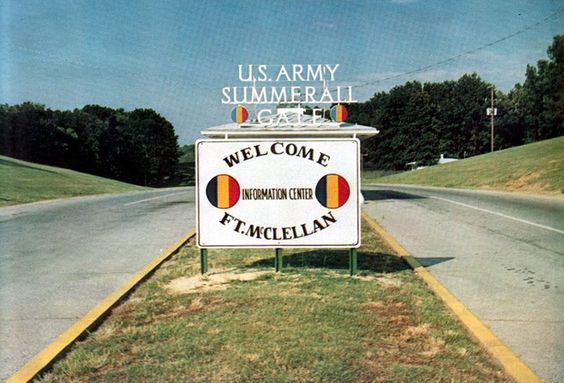
I can tell because I spontaneously started reminiscing about my days at Fort McClellan, to the extent that I looked the place up on Google Maps and started mapping locations.
I must have stared at the map for twenty minutes trying to get my bearings. It might have something to do with trying to do this forty years later. Plus, things just looked different back then. We walked or marched everywhere, and a lot of that happened when it was pretty darned dark. We moved in formation, calling cadence as we marched, and kept our heads pointed forward and our eyes on the troop in front of us.
The MP training barracks are relatively easy to pick out. They’re just not marked on the satellite photos. Ditto the MP School building. I can’t yet figure out where the Training Brigade Headquarters building is or was though. My memory says it was near 40th Battalion’s barracks, but again, that was forty years ago.
I posted a screenshot to a Fort McClellan Facebook group, marked up as I remembered things, and the comments have been interesting. The only thing I supposedly got right was the school, unless they changed the battalions’ locations over the years.
I did discover that two of my old drill sergeants are active in the group and recollected with one of them.
Snow in Alabama
Charlie 40 (technically Company C, 40th MP Battalion) was out on B-44, a bivouac field exercise where we slept in shelter halves and did a bunch of war-like stuff for a couple of days. The advance party that delivered some extra gear ended up stripping our BDU tops off and working in our t-shirts because it was so warm. The next day, it cooled off and we were back in long sleeves. The day after that, it cooled off some more so we put on our field jackets and gloves.
That night, it snowed.
In Alabama.
We knew the snow was coming, so we moved everyone into the hard shelter at the site, which was basically a screened building.
The next morning, there was enough snow on the ground that the transportation unit supporting us wouldn’t bring out our hot breakfast in their five-ton truck. Our company commander brought MREs out to us. In his two-wheel-drive Ford Ranger.
How much snow? I can’t recall. But this was Alabama, so it didn’t take much to shut the post down.
The same transportation unit wouldn’t bring what we called the “cattle cars” out to take us back to the main post.
I don’t remember how far it was back to our barracks, but it was far enough (and cold enough?) that they discarded the idea of just marching us back.
Then they remembered that they had a whole bunch of Humvees sitting nearby, and a bunch of privates who’d just learned how to drive them. These were brand-new vehicles, too. Most of them had fewer than 10 hours on the meter.
But nobody had any better ideas, so we road-marched over to the motor pool, loaded up four MPs per HMMWV, tossed a bunch of duffel bags in each vehicle, and convoyed back to post. I remember that I was lucky enough to be assigned to drive one vehicle, but I don’t recall if we made multiple trips, or what. I also don’t remember how we got the Humvees back to the off-post motor pool.
Memories fade after 40 years.
The Original Little Free Libraries?
Have you ever noticed how we tend to romanticize lighthouses? We imagine how wonderful the solitude must be and how lovely it is to sit there and stare at the ocean waves. Nothing to do but polish the light lenses, light it at the appropriate time, and sit around waiting for the next supply ship to dock. The ship would bring your food, water, mail, and once every quarter, your books.
Books?
A friend shared a post on Facebook talking about portable lighthouse libraries that rotated between lighthouses of the United States Lighthouse Establishment (a predecessor of the US Coast Guard). The quarterly inspection of the lighthouse would bring a new supply of books in a heavy oak box that opened like a bookcase.
Pretty cool concept, I thought. Learn more at Atlas Obscura or the Lighthouse Foundation.
Games
One of my favorite computer game franchises has been SimCity. I remember playing it back in the days of 3.5” floppy disks with various anti-pirating tricks like dark-colored sheets of codes you had to enter. I eventually worked my way up to SimCity4, spending hours upon hours playing the game.
I’ve been playing OpenTTD off and on for several years, too. Love it just as much as SimCity. Some recent discussion on one of the OpenTTD groups led me to reminisce about SimCity, and I wondered what it would take to start playing again.
When we hit the road in the RV, we did a lot of downsizing. Much of that involved the many computer games we had, both for me and the kids. We got rid of the boxes, but kept the CDs, DVDs, and most importantly, the installation codes. I dug those out then did some research.
The game is available on Steam now, and according to what I’ve read at Reddit and Simtropolis and a few other sites, the DVDs won’t work on newer Windows systems. Then I saw a video that suggested Electronic Arts would give you a Steam code so you weren’t paying twice for the game. So I trotted off to EA Support to see what I could find out.
Turns out that they couldn’t validate my activation codes because they’re so old.
I dropped $20 on Steam Thursday, and I’m working my way through several YT videos to get the game modded.
Botched Execution
What does it look like when The State fails to kill a condemned person?
We don’t often know many of the details, because journalists aren’t often allowed to see the part where the state gets ready to kill. They only see the completed setup, after the IVs are in and everything is cleaned up.
Because we can’t let the public see the reality of getting ready to kill someone.
Attorney Maria DeLiberato has seen that reality multiple times, though. In May, she went to Tennessee to watch that state kill one of her clients, despite repeated attempts to have possibly exculpatory evidence tested.
Because Ms. DeLiberato was Tony Carruthers’ attorney, she was allowed to watch the execution team prepare Mr. Carruthers for his killing. The medical team spent 90 minutes, including letting a doctor try to place a central line, even though he hadn’t done one in ten years.
Eventually, Governor Bill Lee postponed the execution for a year.
Ms. DeLiberato wrote about what she saw in a recent NY Times letter to the editor. Read For 90 Minutes, I Watched an Execution Go Horribly Awry via gift link here, or archived link here.
The Surveillance State
Lots of communities have Flock cameras these days.
Flock Safety claims they have systems in 5,000 communities across 49 states (I think Alaska is the holdout). HOAs have them too, which doesn’t make me feel all warm and fuzzy. There’s a subreddit called F***HOAs for a reason.
I’m not thrilled by the idea of a system that can track your travels across your city or the country. And make no mistake, Flock automated license plate recognition (ALPR) can absolutely do that.
“I’ve got nothing to hide, so I don’t care about things like this.”
I don’t have anything to hide either, but it’s nobody’s business where I’m going. You want to track me? Get a warrant.
These systems are ripe for abuse, too.
If you hear that your town is considering Flock cameras (or Motorola, or Axon, or any other ALPR system)? Be present at every meeting that discusses them. Ask about training protocols. Ask who gets to see the data, and how their need to see the data is checked. Be informed about who gets to track you, and who’s looked up your data.
Ask questions.
Thanks for reading. Feel free to share a thought in the comments. Sign up for my infrequent newsletter here. Find some of my other writing at The Good Men Project, too. Subscribe to the blog via the link in the right sidebar or follow it on Mastodon. You can also add my RSS feed to your favorite reader.
Share your thoughts!