Why do you post on social media?
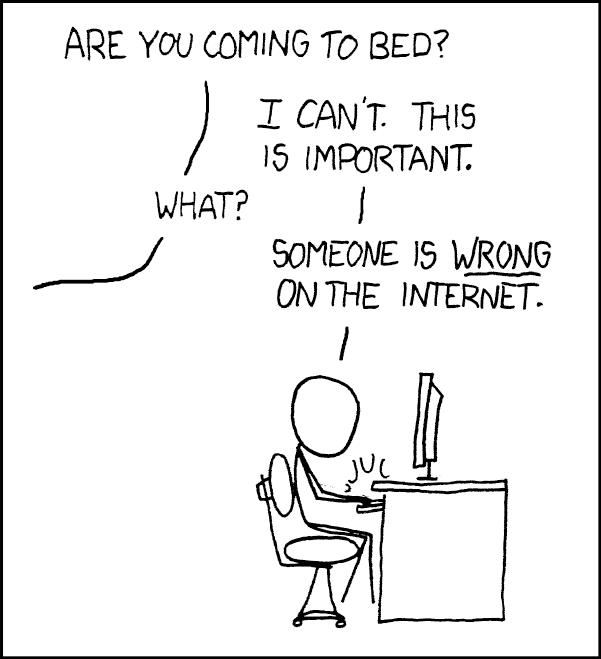
Do you expect people to respond to your posts, or are you more content to shout into the canyon with only the echo of your own voice in response?
I got into a discussion with a high school friend over a post she shared. I disagreed with her position and explained my disagreement as politely and civilly as I could.
Then later, she posted this:
Here’s an idea. If you don’t agree with something I post, SCROLL. I don’t go on your posts and argue with your beliefs.
She went on to add, “Personally I respect what others choose to believe in when it comes to their social media posts. I don’t stir the pot. If one wants a conversation about it with the one that posts it, there’s private messaging for that. Pretty respectful and oh so easy.”
Hmm.
My View
Which is the exact opposite of my way of thinking. When I post something, I expect and want my friends and followers to interact with me. I post stuff up in order for people to pick it apart and make me justify my position. That’s how I learn.
I want you to read my post, read any attached article, and discuss it with me. Give me sources to support your position, especially if it conflicts with mine. I don’t want an echo chamber on my wall. I want it to be a place of discussion and learning.
Isn’t that the whole point of “social” media? To be social? To have a conversation?
On The Other Hand
Have you ever reconsidered your position based on something you’ve read on social media?
My friend said, “Nothing will change my mind over an argument on Facebook.”
But will thoughtful discussion change your mind?
Granted, there’s a difference between a written conversation and one that happens face-to-face. It’s difficult to read intent from fifty or sixty words on the screen. You can’t hear the intonation that people use to emphasize one aspect of a statement. You lose the nuances that body language brings to a conversation.
That makes you have to work harder.
Punctuation matters, too, which is ironic given the way far too many people write on social media these days. Commas matter.

I’m more than willing to change my mind about a topic if I’m presented with enough evidence. Shouldn’t we all be willing to do so?
The question makes me think of Dan McClellan, a biblical scholar I follow on YouTube. His tagline is “Data Over Dogma,” and the more I think about it, the more I think more people need to take that position. If you’re holding a position on an issue and you’re not willing to contemplate changing your mind—even if you don’t change your mind—then your position is more grounded in dogma than facts, and that’s never a good look.
Did you catch that thought I threw in almost as an aside?
I said, “Even if you don’t change your mind.”
You’re allowed to consider alternate viewpoints on an issue.
I don’t necessarily want to make you change your mind about something when I post about it on social media. But I do want you to at least consider the position I hold, especially if it’s at odds with your position. Take some time to think about how I formed my opinion. And if we disagree, I want you to take the time to reasonably and articulately challenge me about my beliefs.
What We’ve Lost
That’s one of the things we’ve lost over the last decades, I think: the ability to form articulate and logical arguments. We got so entrenched in our positions that we refuse to consider the idea that we might be wrong about something.
It’s become a personal insult if someone suggests that we’re mistaken.
We reject evidence that conflicts with our beliefs because that must be “fake news” and sling that phrase around like it’s the instant off-switch to any argument or discussion.
We’ve forgotten how to read articles and posts objectively. Far too few of us have ever learned how to Google competently. I’d venture to guess that most people don’t know about filter bubbles and don’t care to learn about them. Americans these days are far more likely to discount a source because it leans to a political direction opposed to their own, even if the facts supporting the source are valid. That just reinforces the filter bubble effect, though.
Illustration: Back during the 2016 election cycle, I called a friend out on some incorrect information she was spreading, and she told me, “Well, some of us just Google different things.”
Okay, that’s fine. But now that I’ve given you alternative ideas to consider, why not look at those? It’s not the end of the world if you’re wrong, you know. The only way you grow as a human being is to consider new ideas. But she had no interest in giving any consideration to a differing idea, and left the post up.
Then again, that left the links and information I shared available to anyone who might have read the post later.
Why I Do It
And that’s one reason I respond to posts I disagree with. I’m well aware that I probably won’t change the mind of the person who made the original post. But I might convince someone else to at least do some additional research into the topic so that whatever opinion they end up with is at least well-informed.
In the end, I think that’s all we can do.
Have you ever changed your mind at all on a political or social issue? Did a social media post have anything to do with it?
Thanks for reading. Feel free to share a thought in the comments. Sign up for my infrequent newsletter here. Find some of my other writing at The Good Men Project, too. Subscribe to the blog via the link in the right sidebar or follow it on Mastodon. You can also add my RSS feed to your favorite reader.
Share your thoughts!