Now that I’m back from the reunion, the genealogy itch is acting up again.
I did some research in the Louisiana and Texas state archives to see what I could find for the Baldinger line. I didn’t have any real luck finding anything in the Louisiana archives, due in part to the way they’re organized.
The first hit in the Texas archive site I used was a photo of my great great uncle William Henry Baldinger in his Eye, Ear, Nose and Throat practice, which was a pretty cool find. Then I discovered that he’d patented a bottle filling machine in 1891.
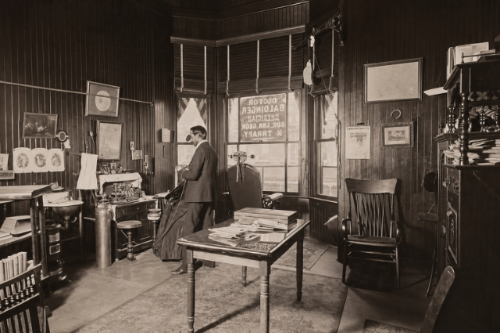
(Click for larger version)
I could ride that endorphin wave for days.
The photo is pretty neat, especially after I had it cleaned up a bit. But the patent I find even cooler. It’s a bit of information that I’d never had before, and something my parents likely didn’t know anything about. I’ve never seen anything in Dad’s research, anyway. William died “without issue” and relatively young. Plus, he wasn’t a direct ancestor of my mother, so there wasn’t much reason to learn more about him. In fact, the only reason I found him was because I did a very broad search for “Baldinger” at The Portal to Texas History at the University of North Texas. It’s a great place for genealogy research. I’ve previously found a photo of the Robert Mueller & Brother furniture store that my dad likely never saw.
That broad search gave me over 7,700 hits, and some of them have been fascinating. There was one ancestor involved in an opium den in 1893 and another who had a stroke while riding a streetcar. “The conductor thought she was suffering from a temporary indisposition and she rode about in the car for an hour and a quarter before a doctor was summoned.”
An hour and a quarter.
She died a week later.
I mean, I get that there were no real treatments for strokes in the 1900s. But waiting over an hour to call a doctor?
Storage Wars
My phone has been yelling at me for a while that I’m close to maxing out my storage. It’s a five-year-old Galaxy S21+ with 128 gigs of storage, so it’s not all that surprising that I’m running out of space. Wednesday morning our internet was out, so I spent part of the day deleting old photos, moving 342 video files over to the computer, and backing up the remaining photos.
And after I stitched together the Smith videos last week and posted them to YouTube, it occurred to me that I could do that with some of the older videos I had on my phone. There are quite a few Nutcracker clips that Middle Daughter would probably like to see, among others. I’ll probably make some time in the next few weeks to work on that.
The Smith videos also lit a fire under me to move forward with digitizing my dad’s old 8mm movies. I salvaged a dozen or so reels dating between 1961 and 1977, each well labeled as to contents. When the ‘net went down Wednesday, I considered heading down to the library to use their Memory Lab equipment, but they were closed for the day due to an HVAC outage.
It’s never easy, is it?
Thirty-two Years Ago
Thursday marked our thirty-second wedding anniversary.
There was a time just twelve years ago that I wasn’t sure we’d make it.
We’ve had some bumps along the way, but I’m glad we’re where we are.
And if you’re married and hitting a rough patch and don’t know what to do? Seek therapy.
By therapy, I don’t mean talking to your best friend or your parent or sibling. I mean a disinterested third party who’s had training in how to listen, and how to encourage you to speak openly to your spouse. Family and friends have biases. Some may not like your spouse. Some may use you and your spouse to help them deal with their own issues. None of that will help you.
Seek therapy and make an honest effort to work with your therapist, even if your spouse isn’t. That’s one of my biggest regrets about the end of my first marriage. Even though my first wife refused to consider therapy, I should have gone on my own. It likely would have helped me see the mistakes I’d made and avoid making them again on down the road.
It would have helped me heal sooner.
You also need to understand that it’s okay if your therapist can’t heal your marriage. Not all marriages can be healed. But that doesn’t mean you got a bad therapist or that you shouldn’t have married who you did. It just means that your relationship came to an end, and that’s okay. All relationships do.
The Last Ship
Diana and I spent the last couple of weeks binging the show. I’ve seen a bunch of clips on YT over the years, so I knew the basic premise of the show.
Not a bad show, really. There were some really eerie comments about conspiracies and so forth regarding the initial virus, considering the show ended two years before COVID hit.
According to IMDB, the Navy presented the producers, cast and crew with the Navy Distinguished Public Service Award to thank them, in the words of SecNav Ray Mabus, for “getting the Navy right.”
About that…
Being a former leg MP, I don’t have the knowledge to critique most of the Navy stuff from the show, like terminology, commands in combat, and so forth. But there are a few things I feel comfortable bringing up. Like all of the operator types firing full-auto in every gunfight. Full-auto fire looks cool, but it’s a waste of ammo, and US military service members are trained to fire semi-auto in most situations.
Also, Arleigh Burke DDGs (the fictional Nathan James is such a ship) only have about 25 officers in the crew. It seems like a lot of the officers on James performed a lot of jobs that enlisted crew would normally perform. I had a hard time accepting the number of times officers went ashore with the combat teams.
And I found it interesting that the late Eric Dane even got to the point that the show wasn’t that fun for him.
But overall, I enjoyed it.
Elseread
Reason Magazine has a podcast episode up about Paul Skalnik, whose jailhouse informing has sent dozens of people to prison, including to death row. But is his information accurate? And why doesn’t a platform like Reason have even basic auto-generated transcripts?
The Magnolia Tribune has an op-ed entitled, “When junk science decides guilt in the South.” Written by a former chair of the Arkansas Senate Judiciary Committee, a former FBI agent, and a legal fellow at Unify.US, the piece talks about how junk science still sends people to prison and Death Row, then discusses changes to federal evidence rules aimed at fixing junk science.
Thanks for reading. Feel free to share a thought in the comments. Sign up for my infrequent newsletter here. Find some of my other writing at The Good Men Project, too. Subscribe to the blog via the link in the right sidebar or follow it on Mastodon. You can also add my RSS feed to your favorite reader.
Share your thoughts!